Circular product design · industrial machinery
Design machinery that can keep delivering value.
A machine may still be mechanically sound while its controls become obsolete, a component is inaccessible or the customer’s needs change. Circular product design makes maintenance, repair, upgrades and next use part of today’s design decisions.
Discuss your machine caseCircular product design goes beyond material selection.
Material use and recycling matter. For complex machinery, circular product design also means preserving a useful product, replacing an obsolete subsystem and finding a next use for valuable components. Technical possibility alone is not enough: an intervention also needs to be economically and operationally feasible.
Treeline helps industrial manufacturers connect these questions with product strategy and development. We examine one machine or product family with the people responsible for its design, market and use.
From a future intervention to a design decision
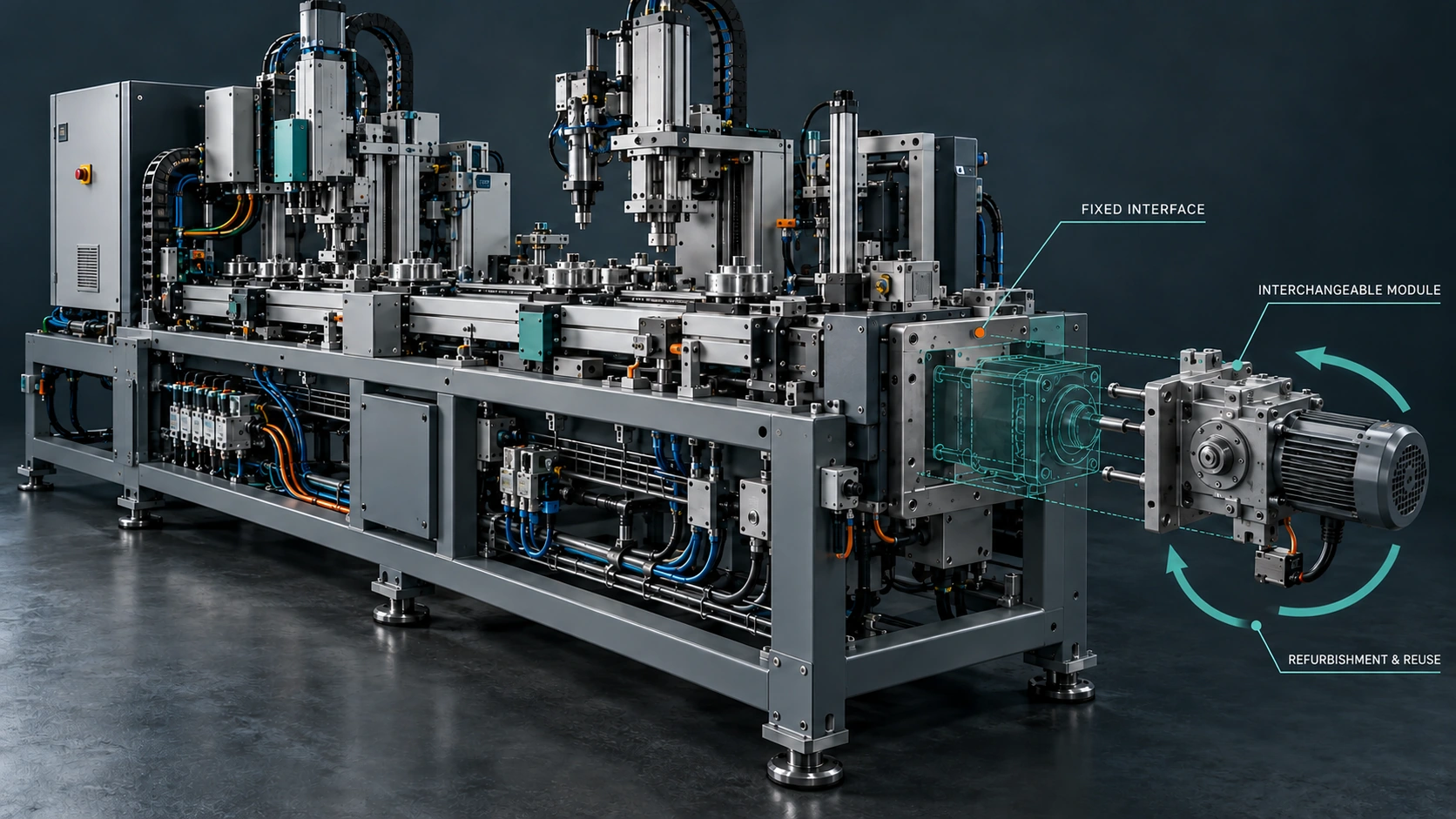
Suppose you want to renew a control module after several years while keeping a serviceable frame. Mechanical connections are only part of the question. Interfaces, software dependencies, access, safety and information about the installed configuration also determine whether the upgrade is feasible.
We examine which value you want to retain or add, which intervention it requires, and what the machine must enable. This is an illustrative example, not a completed client case.
TLDF makes the trade-offs explicit.
The Treeline Lifecycle Design Framework (TLDF) is my approach to connecting circular product design with value throughout the lifecycle. Four possible value moments help us look beyond the first sale: sale and commissioning, availability in use, retrofits and upgrades, and a next use cycle.
Three design strategies turn this into practical questions:
- Design for Disassembly: can we safely access, remove and reinstall the relevant part?
- Design for Modularity: can a subsystem change without replacing the valuable remainder?
- Design for Diagnosis: do we know enough about configuration, condition and history to decide on the intervention?
TLDF is a proprietary working approach, not a certification or evidence of regulatory compliance. We test the expected value and feasibility for each case.
What a first application produces
We select a specific intervention, such as replacing a wear part, a retrofit or redeployment. Together with engineering, product management and service, we identify the obstacles and assumptions.
- A chosen lifecycle intervention and the value you aim to retain or create.
- Design and information questions covering architecture, access, compatibility and diagnosis.
- The economic, operational and environmental assumptions that still need testing.
- An initial test or next step, with an owner and a decision point.
A workshop can be a suitable starting point. In an ongoing development project, working directly on a specific design trade-off may be more useful.
Practical questions
Is a longer service life always the best choice?
No. Energy use, performance, safety, costs and the environmental burden of an intervention also matter. Life extension is a route to examine, not automatically the best outcome.
Can we apply this to existing machinery?
Yes. Existing machinery can reveal obstacles to repair, upgrades or redeployment. Some improvements can be retrofitted; others require a next product generation. We make that distinction explicit.
How does this relate to Configure-to-Order?
Both may benefit from a modular architecture. Configure-to-Order primarily organises variety when delivering a customer solution. Circular product design also considers change, maintenance and next use after delivery. The right module boundaries are not necessarily the same.
Let’s talk
Discuss your machine case
Which repair, upgrade or next use do you want to enable? Tell me about the machine and what currently gets in the way.
Send Jasper your question